Thursday, June 23, 2011

lately

Five Things About the Mutation of Fortune at HTMLGiant

Fiction Review of The Mutation of Fortune at Newcity Lit

+++

I also recently had the honor to read for the Neverwhere Literature Contest, sponsored by Depaul University and One Book, One Chicago.


imagined landscape, collage, 2009

Thursday, May 19, 2011

the mutation of fortune


"THE MUTATION OF FORTUNE documents the parallel fortunes of one protagonist living multiple lives. As she navigates her Märchen landscape, she goes through varied transformations, becoming at times a wolf, a thief, an amputee, a hunter, a rabbit and a runaway. She sleeps with swans and suffers a sister that bites the back of her knees. The world of this book is unstable, delicious and carries with it an inexplicit sense of danger."

available at the paper cave and quimby's in chicago (online & store).

& an interview about the book, wherein i speak of psychic inheritance, 2nd grade science teachers, and magic.

Friday, February 25, 2011

diamond fingers


something made many moons ago

Wednesday, January 26, 2011

bleeding trees


blood as a sign of wounding:::


--William Tell,Friedrich Schiller, 1804.

"Down to 1859 there stood a sacred larch-tree at Nauders in the Tyrol which was thought to bleed when it was cut; moreover people fancied that the steel pierced the woodman's body to the same depth that is pierced the tree, and that the wound on his body would not heal until the bark closed over the scar on the trunk."
--The Golden Bough: A Study in Magic and Religion, Sir James George Frazer


Codex Borgia (c. 1497, Mixtec-Puebla Culture. A Mesoamerican ritual and divinatory manuscript) plate 66, blood gushing from trunk

There is, in the churchyard at Nevern, an ancient tree known as Yr Ywen Waedlyd, 'The Bleeding Yew'. A blood red sap flows from its trunk.
Some say it bleeds because a monk was hung to death there, and the blood is a sign of his innocence. Others believe Jesus Christ was crucified on a cross made from the yew tree, and that the tree bleeds in sympathy. Another legend proclaims that the tree will continue to bleed “until there is a Welsh prince on the seat at Nevern Castle.”


The Bleeding Yew

The tree in this distinct pictoria [folio 13r of Codex Telleriano-Remensis] is laden with flowers; its trunk is split in half, and its roots are fully exposed, and bleeding. The accompanying text says: Tamoanchan xochitlycacan, meaning: "Tamoanchan, (where) the flowers are in its house." The broken Flowery Tree here definitely symbolizes the breaking away from Paradise - from the primordial state of things, and from the House of the Gods from which, as the text explains, men had been expelled by orders of the male and female gods, for having harmed both trees and flowers there.
--Social Memory in Ancient and Colonial Mesoamerica, Amos Megged


Codex Telleriano-Remensis (Mexico, 16th century), folio 13r

"There is a story that tells how, when a musician cut a piece of wood from a tree into which a girl had been metamorphosed by her angry mother, he was startled to see blood oozing from the wood."
--Plant lore, legends, and lyrics: Embracing the myths, traditions, superstitions, and folk-lore of the plant kingdom, Richard Folkard, 1884

Wednesday, December 22, 2010

<><><>

and through the porthole they can make amends

Thursday, December 16, 2010

collecting an image

Francis Alÿs: Fabiola at the National Portrait Gallery, London


oh fabiola, you are a diamond. but with my diamonds i must make them again. it is the remove that intrigues me --


---Mary Rowlandson, Narrative of the Captivity and Removes of Mrs. Mary Rowlandson: who was taken by the Indians at the destruction of Lancaster, in 1676

first there was fabiola.
then, the copy, a painting. over a thousand years after her death. lost, now.
and then, more copies. which duplicate an original that no one has seen or touched.

original: fabiola the human or fabiola the first-painting?

Monday, December 6, 2010

whitman

fortuna


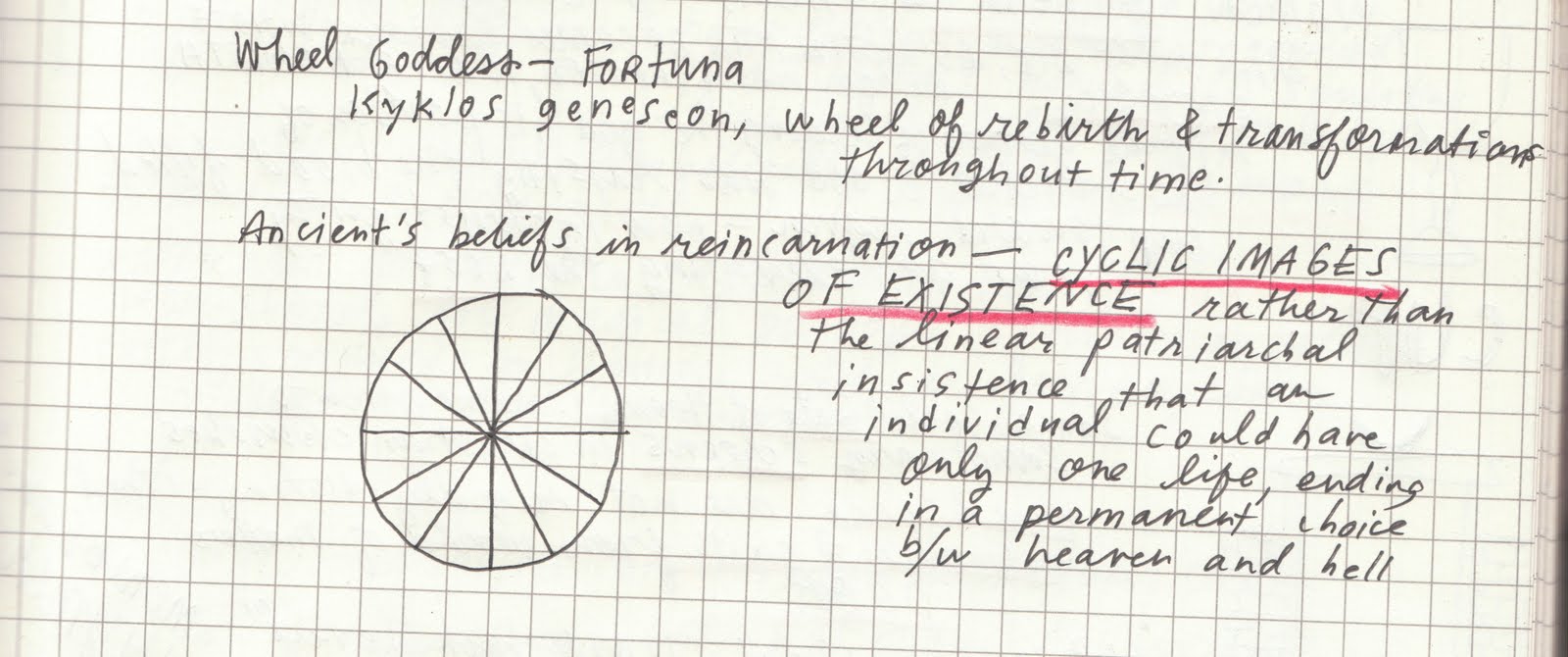
notes on the wheel of fortune -- living multiple lives, scanned

Friday, December 3, 2010

experience to believe


MS M.106 fol. 88v, Pierpont Morgan Library, New York


--from Emily Dickinson's Master Letters

....and i always thought thomas was the saint of proof. but remember, he is called doubting thomas for a reason.
he must experience -- find his proof -- in order to believe.


<><><>


--April D. De Conick, The Original Gospel of Thomas in Translation. The Gospel of Thomas was believed to be a "false gospel" by the early church, and not included in the Bible. It was (re)discovered near Nag Hammadi, Egypt, in December 1945, in one of a group of books known as the Nag Hammadi library.

<><><>

"That the Doubting Thomas ampullae [flasks] were created to evoke a popular holy site or revered relic seems unlikely, since none of the early pilgrim texts makes more than a passing reference to the fact that the event was thought to have taken place at Holy Sion; moreover, the inscriptions on both flasks leave no doubt that they, like the others, contained sanctified oil from the Golgotha Cross. It seems more probable to suppose that the portayal of this scene on this object was intended to remind the pilgrim of the Gospel account of Thomas' incredulity [..] Doubting Thomas provides an obvious biblical parallel for the pilgrim and his own experience. Significantly, the words on the flask, “My Lord and My God," are those which come from Thomas' lips at the moment when, like a pilgrim, he touches and believes."
--from Gary Vikan's brilliant essay, "Byzantine Pilgrimage Art", which can be read here.


Doubting Thomas Pilgrim Ampulla (Flask), note the DIAMOND -- Monza, Treasury of the Cathedral of St. John the Baptist (Jerusalem ca. 600)

Wednesday, November 24, 2010

words of power

vulnerable/vulnerableness/vulnerary/vulneration/vulnerose/vulning/vulnus
from the Universal Etymological English Dictionary, 1731


Vulnerary Herbs: promote healing of wounds with broken skin such as abscesses, eruptions and cuts.

“The Hidden Name was secretly inscribed in the innermost recesses of the Temple, guarded by a sculptured lion. If, as was most unlikely, an intruder saw the name, the lion would give such a supernatural roar that all memory of it would be driven from his mind. But Jesus knew this, he evaded the lion, wrote the Name, cut his thigh open and hid it within the wound, closing it by magic. Once out of the Temple he re-opened the incision and took out the sacred letters.”
--The Law and the Word, 1919, Thomas Troward

"The Pitt diamond, it is said, was found in Golconda in the year 1702, by a slave, who, being desirous of keeping the stone to himself, made a wound in his thigh, placed the diamond in the wound, and covered it over with a bandage."
--Picturesque Science, for the Young

Friday, November 19, 2010

lineage


Sebastian Munster, Europe as a Queen, Basel 1570

what we learn from the middle ages, from the world:
the body teaches us about enclosure: the blood is enclosed by the body.

the blood defines the individual. and the blood defines the collective. and the blood is proof of existence. and the blood must be kept enclosed.

bleeding endangers the integral. consanguinity. there is no introduction for bad blood: the other, outsider cannot wave hello. the skin is a fence for blood. the nation is a fence for blood.


Consanguinity Chart
from the Etymologies by Isidore of Seville
Prüfening, Germany; ca. 1160–65
Bayerische Staatsbibliothek, Munich, Clm. 13031


"Girls of fortune, we, and this is the first time, here in Brighton, that we call ourselves fortunate, perhaps because we're talking about our past, know that we come from a long and glorious lineage. Of death. For one of the meanings of the word lineage is 'dead.'"
--Kathy Acker, Pussy, King of the Pirates


The genealogical tree of Noah from 'Rudimentum Novitiorum' (Handbook for Beginners), Lübeck, 1475

"Lineage and blood relate... to every ordering by kinds, where every stranger,every strange thing, marks the absence of neutrality [...] We institute our hierarchies of blood in a forgetting that pretends to neutrality without responsibility. [..] Kinds in lineage and blood come forth in ambiguous profusion, overlaying, overlapping, intermingling beyond any system of classification."
--Stephen David Ross,The Gift of Kinds: the Good in Abundance: an Ethic of the Earth

"..All margins are dangerous. If they are pulled this way or that the shape of fundamental experience is altered. Any structure of ideas is vulnerable at the margins. We should expect the orifices of the body to symbolize its especially vulnerable points.
--Mary Douglas, Purity and Danger: an Analysis of Concept of Pollution and Taboo

also: Bodies, Buildings, and Boundaries:
Metaphors of Liminality in Old English and Old Norse Literature

Thursday, October 14, 2010

red riding hood says,


visit the web issue of the inimitable fairy tale review. the wolf sent me.

Saturday, October 9, 2010

more fingers, more proof


detail from late 12th c. manuscript leaf at the Art Institute of Chicago


"[The Pope] holds the host with his left hand and points toward a chalice on the altar with his right. [...] A strange object, which appears to be a finger, rest on top of the chalice. Two sets of creases, visible underneath, mark its joints, and a fingernail has been delineated at the upper right."
--from "An Early Image of a Mass of St. Gregory and Devotion to the Holy Blood at Weingarten Abbey", Michael Heinlen, in Gesta, Vol. 37, No. 1

St. Gregory (Pope Gregory I) was saying mass when a woman present started to laugh during Communion, saying to a companion that she could not believe the bread was Christ, as she herself had baked it. Gregory prayed for a sign, and the host turned into a bleeding finger.


from The Sacred Shrine a Study of the Poetry and Art of the Catholic Church by Yrj Hirn, 1912


relic of the finger of thomas the apostle, rome, italy (my photo, taken 6/2009)

Thursday, September 23, 2010

if you do, it will bleed


bloodroot harvested from a forest in northern wisconsin

"You make something resembling blood. If there were a way home it would be a mystery, Flannery O’Connor might say. No use trying to prattle your way into mystery. But tell what you see, tell what the blood was like, and maybe a gesture will form. Probably unbearable. Certainly unclean. And then you will go ahead with your exile."
--Anne Carson, from "Untitled (Flannery)"


bloodroot

"And I thought/Of the tongue, of how it is a wound, a pool of blood,/And of how you should bind a wound."
--from "Pale Rider", Brigit Pegeen Kelly


--from the Revelations of Saint Gertrude