Wednesday, September 23, 2009

here, and here


writing that can be read:

denver quarterly, v.44 n.1
finalist for the annual experimental fiction contest, diagram

lately, also: string, captivity narratives, & digestive enzymes---

Friday, September 4, 2009

of diamonds and wounds, venice


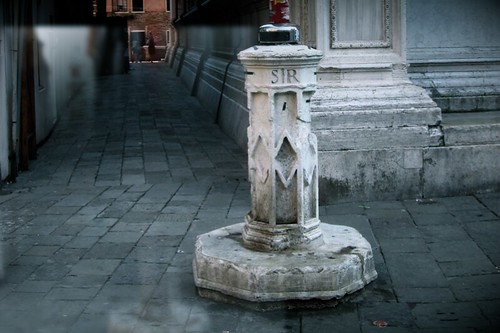
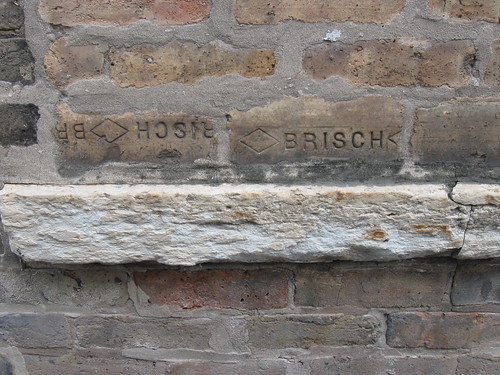
Photograph from my journey to Italy: A <> Sir, discovered in June 2009, Venice


Sir, I must have that diamond from you.--
There, take it.
--Shakespeare, Comedy of Errors, Act v

The Scuola Grande Di San Rocco, or the Confraternity of St. Roch, was built in Venice in the early 16th century. Saint Roch, or Rocco, or Rock was expelled from his healing mission in the town of Piacenza, and withdrew into the forest, where he made himself a hut of boughs and leaves. He would have died, if a dog had not come to him, supplying him with bread and licking his wounds, healing them. He is usually represented in the garb of a pilgrim, lifting his tunic to demonstrate the wound in his thigh.

Saturday, August 15, 2009

As Above, So Below

Central Anatolia, Prayer Rug. 17-18c

"I have become convinced that a [woven] carpet [as having reached their pinnacle in early Turkish village carpet weaving], when it is a good one, reverberates with some kind of primitive and archetypal force, that it has in it some kind of being, that it connects with some primitive, almost animistic “soul of the world” — and that the carpet must be judged, in the end, according to the degree to which it does, or it does not, make a connection with this force.

In this sense, it is in its power, very much like the great bronze castings of the Chinese Shang dynasty, which establish an almost magic force, by establishing themselves as beings, in some realm, which connects us to itself, to which we are connected, which is an absolute realm of beings, and whose functioning is almost entirely animal-like, spirit-like, not matter-like, almost conscious — it is as if the thing, the bronze, or the carpet, establishes itself in my own belly, as a voice, speaks with my own voice, exists with my own force, and forces my awareness of an ultimate mother, or an ultimate creature of which I am a part — and which exists in me.

This nearly animistic view of carpets is consistent with the recent discoveries, already mentioned, that have centered around the tradition of prehistoric art in Central Anatolia. The essence of the view which lies behind these discoveries, is that what we naively call beauty, and what we experience as artistic force, lies in the creation of an object which speaks directly with my own inner voice, that there is, at the heart of all things, a single voice of universal blackness and thickness and light, that speaks in all tongues, and that holds all force into itself.

A carpet, when it holds the almost magical force which all carpet lovers recognize, holds this force, because, to some degree, it embodies this original voice, lets us see this original animal force that exists in ourselves. I believe the same is true, of every artifact. As a builder, I am trying, every time I make a building, to reach a connection with this force, and to make a thing, which fills us, with this animal and animistic force. The force, though primitive, and almost alien, is that underbelly of ourselves, which makes us human. Though unrecognizable, and almost taboo, because it is by turns violent, lustful, peaceful, and absurd, is nevertheless that thing which, to the degree it comes to life in us, makes us live innocently as people in the world."

--From Foreshadowing of 21st Century Art: The Geometry of Very Early Turkish Carpets, Christopher Alexander

Thanks to: The College of Mythic Cartography

Monday, June 8, 2009

the switch


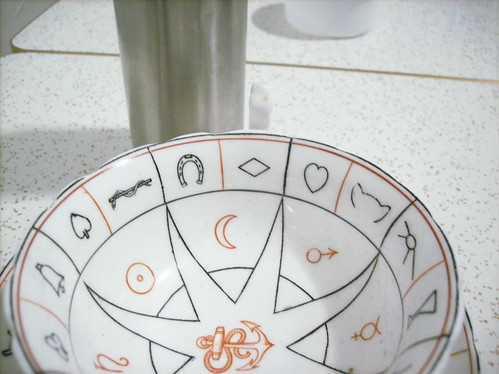
fortune telling card, my collection

Thursday, June 4, 2009

aretalogy


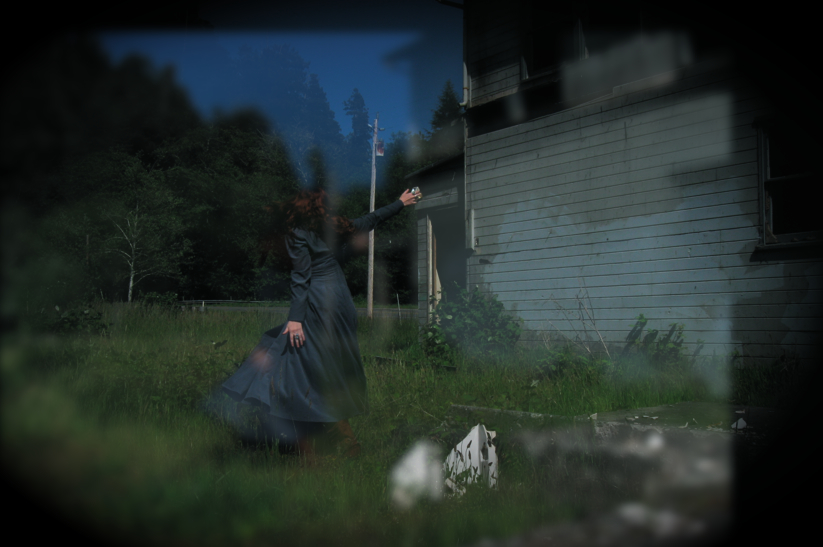
from recent journey, self- portraits at abandoned house

Monday, May 4, 2009

the book of the heart

The heart can be opened, read and interpreted like a book. For Clare of Montefalco, her "spiritual sisters came to believe so intensely that Christ had painted his cross in her heart that at her death in 1308 they threw themselves upon her body, tore out her heart, and found incised upon it the insignia of the Passion." Or, after the death of Ignatius of Antioch, "they took the heart out of his body, split it down the middle, and found there the name of Jesus Christ inscribed in gold letters ..."
see: Eric Jager, "The Book of the Heart: Reading and Writing the Medieval Subject"


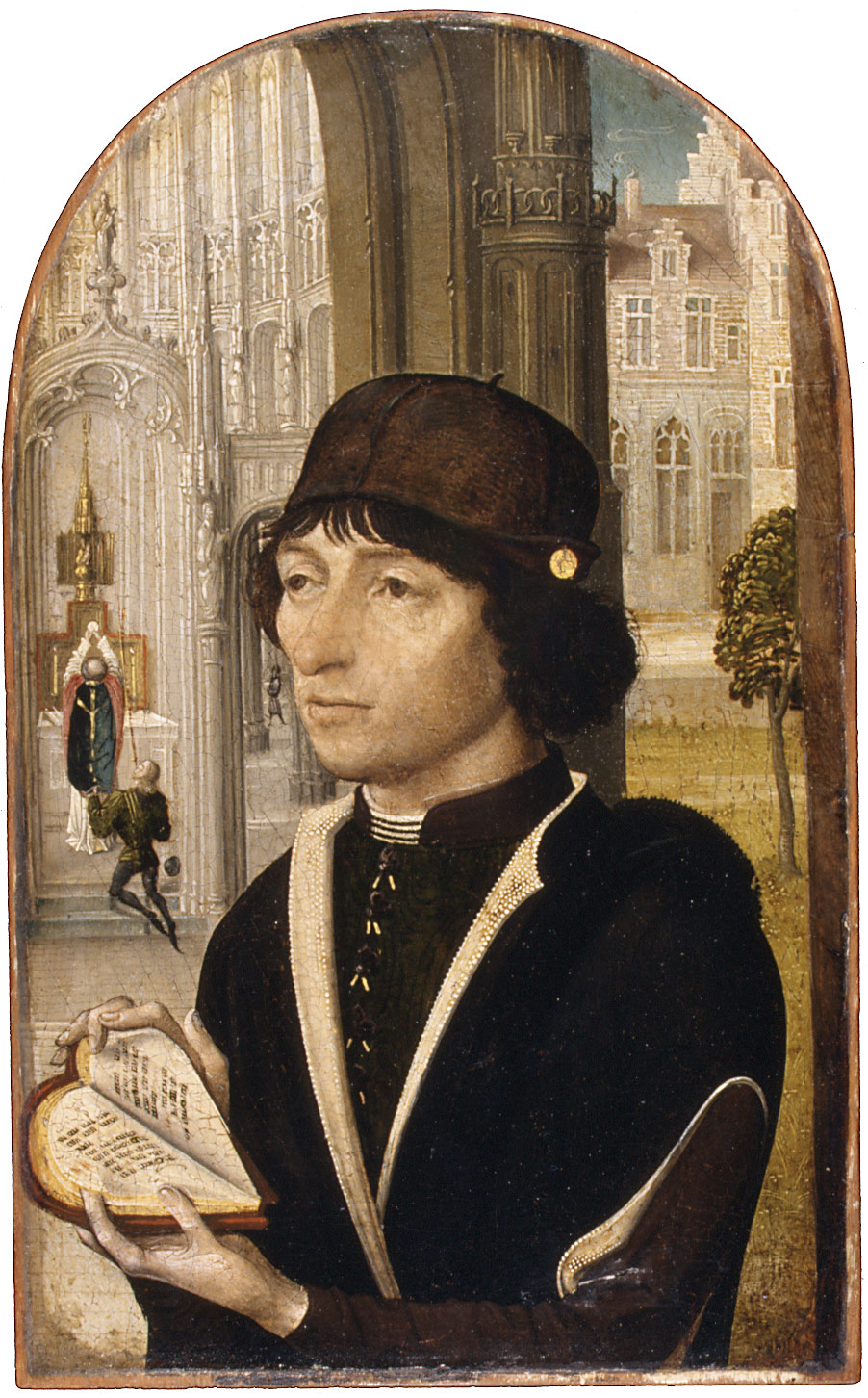
Master of the View of Sainte Gudule, Young Man Holding a Book, ca. 1480

"This is what I want to do in my heart, in front of you, in my confession, and with my pen before many witnesses."
--St. Augustine, Confessions

Thursday, April 30, 2009

a desperate light

Today when the sun began with its shafts
to tell the story, so clear, so old,
the slanting rain fell like a sword,
the rain my hard heart welcomes.


I must renew my bones in your kingdom,
I must still uncloud my earthly duties.


(words from Pablo Neruda's "The Separate Rose: I")

Wednesday, April 8, 2009

When You Imagine, You Compel the Stone to Put Forth Its Hidden Nature

"Meditation: the name of an Internal Talk of one person with another who is invisible, as in the invocation of the Deity, or communion with one's self, or with one's good angel."
--Martin Rulandus, Lexicon of Alchemy, 1612


Giovanni di Paolo, St. Catherine of Siena Exchanges Hearts with Jesus


"It appeared to her that her Heavenly Bridegroom came to her as usual, opened her left side, took out her heart, and then went away."
--Raymond of Capua, Life of St. Catherine of Siena

Wednesday, April 1, 2009

here, two eyes have once more become one


medieval alchemical texts, reworked + collage + drawings

Thursday, March 19, 2009

<>


Saturday, February 21, 2009

beating the bounds


Bartholomeo Eustachi (1500-1574), Tabulae Anatomicae


"In order that the boundaries of the parishes might be indelibly impressed on the minds of the younger portion of the community, it was deemed advisable to bump some promising boy painfully against the boundary stones; or better still, to publicly whip him while he strove to impress on his memory the exact position of the same landmarks."
--William Andews, Curiosities of the Church, 1895

"Children were originally the chief boundary-beaters thrashing away with their sticks on the relevant stone, tree, or other landmark which marked the edge of a town or parish. And the children were, in turn, beaten themselves, receiving a coin for their pains. Boys were pummelled with the sticks, ducked in waymarking ponds, dragged through intruding hedges, and even had to climb over building that straddled the boundary. This instilled in them a sense of place, with a wound for every landmark."
--Quentin Cooper, Maypoles, Martyrs & Mayhem: A Diverse and Diverting Guide to 366 Days of British Myths, Customs & Eccentricities

"... The outskirts are felt to be infected zones, where all kinds of monstrosities are possible, and where a different man is born, an aberrant from the prototype who inhabits the centre of things."
--Piero Camporesi, The Incorruptible Flesh: Bodily Modification and Mortification in Religion and Folklore

Thursday, February 19, 2009

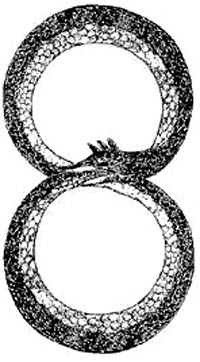
EIGHT:::

"[The Christian's] fundamental belief in the efficacy of baptism led him to find this mystical symbol everywhere and imbue it with Christian meaning. The Lord rose on the eighth day: on an Easter Sunday, the liturgical eighth day, the Christian received baptism; and this is the day on which the 'Spirit moved upon the face of the waters.' Eight persons rode the ark over the waters, and this wooden structure by which man was saved is a symbol of the Cross."
--Hugo Rahner, Greek Myths and Christian Mysteries

"For Christ, the first born of all creation, is become the beginning of a new race, the race of those who by virtue of the mystery of the cross are born again of him by water and faith and the wood."
--Justin Martyr, Dialogus cum Tryphone, 2nd century

Early Christians tended to build their baptisteries in octagonal form, with an eight-cornered rail.


"The holy temple has eight niches,
octagonal is the font, worthy of its sacred work.
The house of our baptism must be built in the mystical eight."
-- from a Latin inscription by St. Ambrose on the baptistery of St. Thecla at Milan, 4th century


"... the ogdoad is understood frequently as the dual four, which is identical with the below and above, the boundless infinite, from whom emanated the Logos, or Word."
--Marie L Farrington, Facing the Sphinx, 1889


"The Ogdoad was a company of eight creator-gods a Hermopolis (ancient name Khmnu, 'City of the Eight'), one of the oldest religious centers in Egypt. The eight gods comprised four male-and-female couples, who each personified aspects of primeal chaos: Nun and Nunet (the waters), Heh and Hehet (the flood), Kek and Keket (the darkness), and Amun and Amaunet (invisible wind). [...] The Ogdoad are thus called 'the fathers and mothers who made the light', 'the men and women who created the light', or 'the waters that made the light'."
--Alan F. Alford, The Midnight Sun: The Death and Rebirth of God in Ancient Egypt

Tuesday, January 20, 2009

collection:


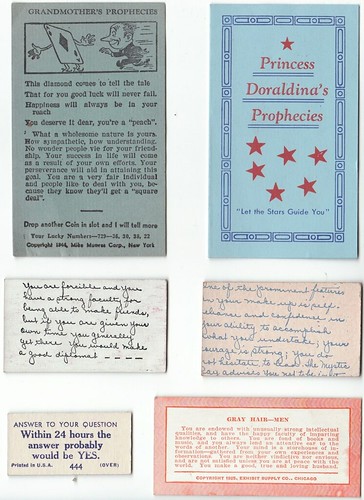
cards "printed" from fortune telling vending machines, my collection

Sunday, November 2, 2008